Product Brief with AMD EPYC 7003

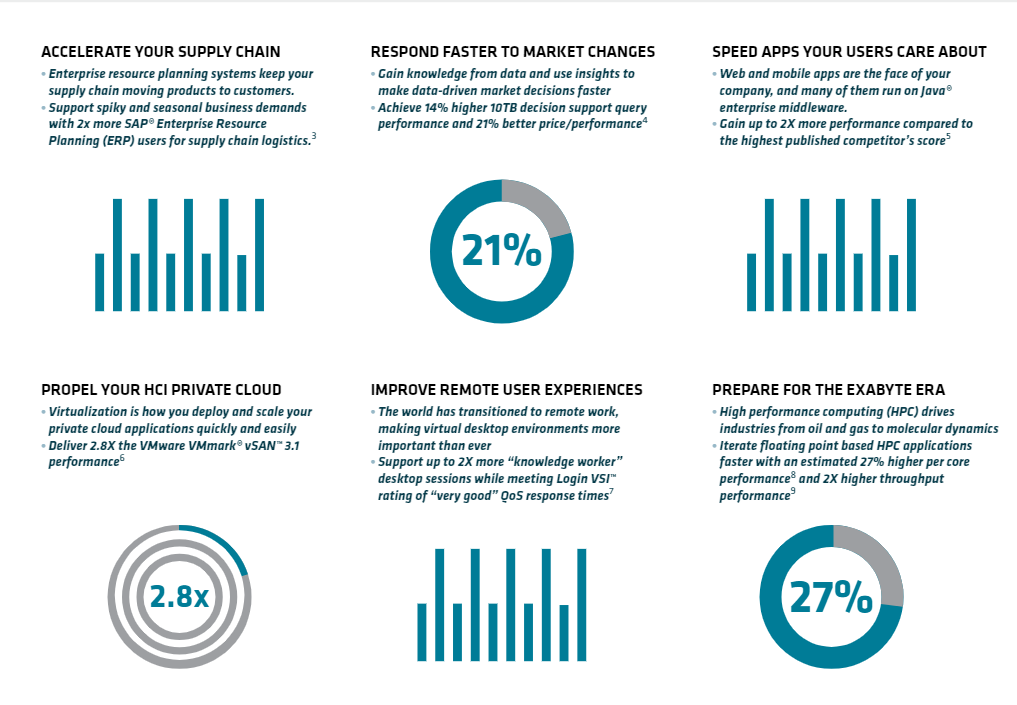
3rd Gen AMD EPYC™ processors raise the bar once more for workload performance, with up to 19% more instructions per clock (IPC)1. No matter the job, you can drive faster time to results, provide more and better data for decisions, and achieve better business outcomes. With our leadership approach, the world’s highest performance server CPU, AMD EPYC 7763,2 and AMD Infinity Architecture deliver innovation —up to 32MB of L3 cache per core, synchronized fabric and memory clock speeds designed for improved performance, plus hardware and virtual security features to help safeguard your business—right out of the box

AMD EPYC Product Brief (Technical | In-depth details about your new AMD EPYC 7003 Series Processers (pathfactory.com))
References:


Introducing 3rd Gen AMD Processors for the Modern Data Centre

Join CEO Dr. Lisa Su, CTO Mark Papermaster, Senior VP and GM of Datacenter and Embedded Solutions Business Group, Forrest Norrod, Senior VP and GM of Server Business Unit, Dan McNamara, and appearances by industry-leading data center strategic partners and customers in this digital launch of the 3rd Gen AMD EPYC™ Processors.

Chapters:

00:00​ – Intro
01:00​ – Introducing 3rd Gen AMD EPYC
07:48​ – “Zen 3” Architecture for Data Center
15:24​ – 3rd Gen AMD EPYC Portfolio & Performance:
20:44​ – HPC Performance Leadership & Exascale Computing
25:44​ – Powering the Most Important Cloud Services
35:54​ – Accelerating Enterprise Workloads
40:42​ – AMD EPYC Solution Ecosystem
49:22​ – Conclusion

Analyzing Memory and Threading Correctness for GPU-Offloaded Code

Modern workloads are diverse—and so are architectures. No single architecture is best for every workload. Maximizing performance takes a mix of scalar, vector, matrix, and spatial architectures deployed in CPU, GPU, FPGA, and other future accelerators. Heterogeneity adds complexity that can be difficult to debug. This article introduces the new features of Intel® Inspector that support the analysis of code that’s offloaded to accelerators.

For more information: Analyzing Memory and Threading Correctness for GPU-Offloaded Code

Hewlett Packard Enterprise selected to build new supercomputer for the National Supercomputing Centre Singapore

The next generation national supercomputer for Singapore will be a green, warm water-cooled system – one of the first known deployments of such a system in a tropical environment. When operational the supercomputer is expected to provide an aggregate of up to 10 PFLOPS of raw compute power and is eight times more powerful than the current ASPIRE1 supercomputer. ASPIRE1, which was commissioned in 2016, has been running at near full capacity in support of local advanced research that requires high-end computing resources. The new system is the first in a series of supercomputers that will be deployed in phases from now till 2025 to expand and upgrade Singapore’s high-performance computing (HPC) capabilities for the research community here.

– National Supercomputing Centre Singapore –

For more information,

Extremely Low Thermal Conductivity material to insulate Space Craft

This video was demonstrated in 2011 and yet even now in 2021, I am still fascinated with science. Picking up a block at 2200 degree F with bare hand…. Wow… Enjoy

For more information, do take a look at

For more information about the Space Shuttle thermal tiles, how they work, what they are made of used on the Space Shuttle see Thermal Protection Systems. Enjoy

Intel 5G Vision: Unleash Network Modernization

https://www.intel.com/content/www/us/en/wireless-network/5g-vision-dan-rodriguez-unleash-network-modernization-video.html

5G is so much more than just delivering better broadband. It’s also about enabling service providers to deliver all sorts of vertical market, specific applications to unlock and unleash the potential across a wide variety of industries. And with that, we expect the network to truly be transformed, be very flexible, be very server-like, and utilize all sorts of cloud technologies to unleash the potential of all these wide variety of use cases.

Intel