320 mini computers make mega mainframe

The Full Article can be found at Supercomputer at SSCC: 320 mini computers make mega mainframe

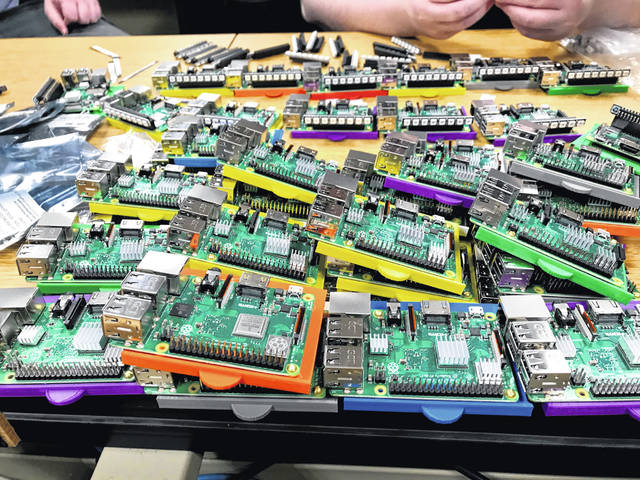
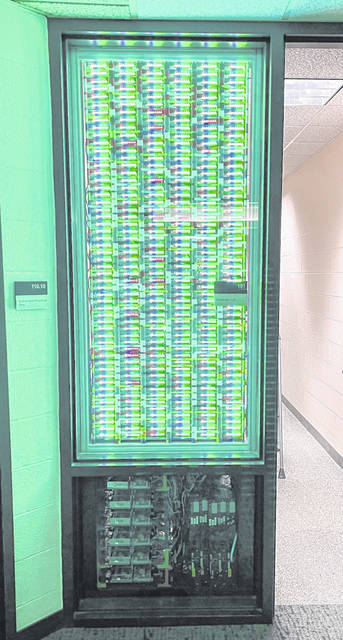
A supercomputer capable of searching the outer limits of space for alien life and helping stop the spread of COVID-19 is located close to home at Southern State Community College, where computer science students learned valuable knowledge and skills in their field by building it themselves. “This is an amazing example of student-selected, project-based learning,” said Computer Science Professor Josh Montgomery. “This project took a wide range of skills to complete.”

According to Montgomery, the supercomputer is composed of 320 Raspberry Pi 3 mini computers with access to 1,280 processing cores and 320 gigabytes of Random Access Memory storage, making it a powerful device with many capabilities. Montgomery said the computer has crunched data for programs like the Search for Extraterrestrial Intelligence, which is an effort to detect evidence of technological civilizations that may exist elsewhere in the universe, particularly in our galaxy, according to its website.
References:

Supercomputer at SSCC: 320 mini computers make mega mainframe
Delays in Intel Sapphire Rapids Production to Q1 2022

From the Next Platform

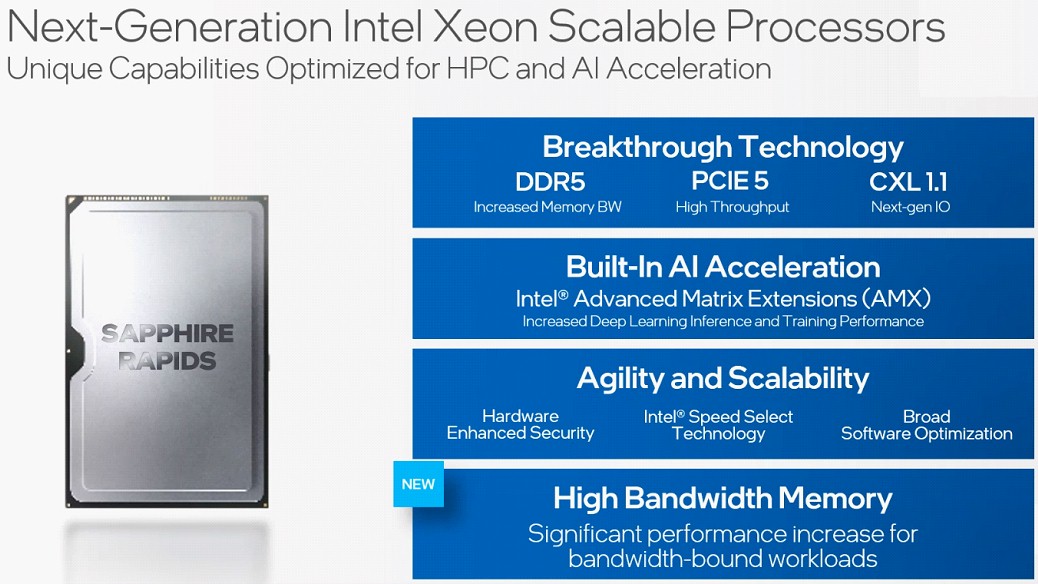
Intel has delayed production of its next-generation Xeon Scalable CPUs, code-named Sapphire Rapids, to the first quarter of 2022 and said it will start ramping shipments by at least April of next year.

Spelman said Intel is delaying Sapphire Rapids, the 10-nanometer successor to the recently launched Ice Lake server processors, because of extra time needed to validate the CPU.

“Given the breadth of enhancements in Sapphire Rapids, we are incorporating additional validation time prior to the production release, which will streamline the deployment process for our customers and partners. Based on this, we now expect Sapphire Rapids to be in production in the first quarter of 2022, with ramp beginning in the second quarter of 2022,” Spelman wrote.

CRN (Intel Delays Sapphire Rapids Xeon CPU Production To Q1 2022)

For more information, do read Intel Delays Sapphire Rapids Xeon CPU Production To Q1 2022

References:

China unveiling an advanced 66-qubit quantum supercomputer

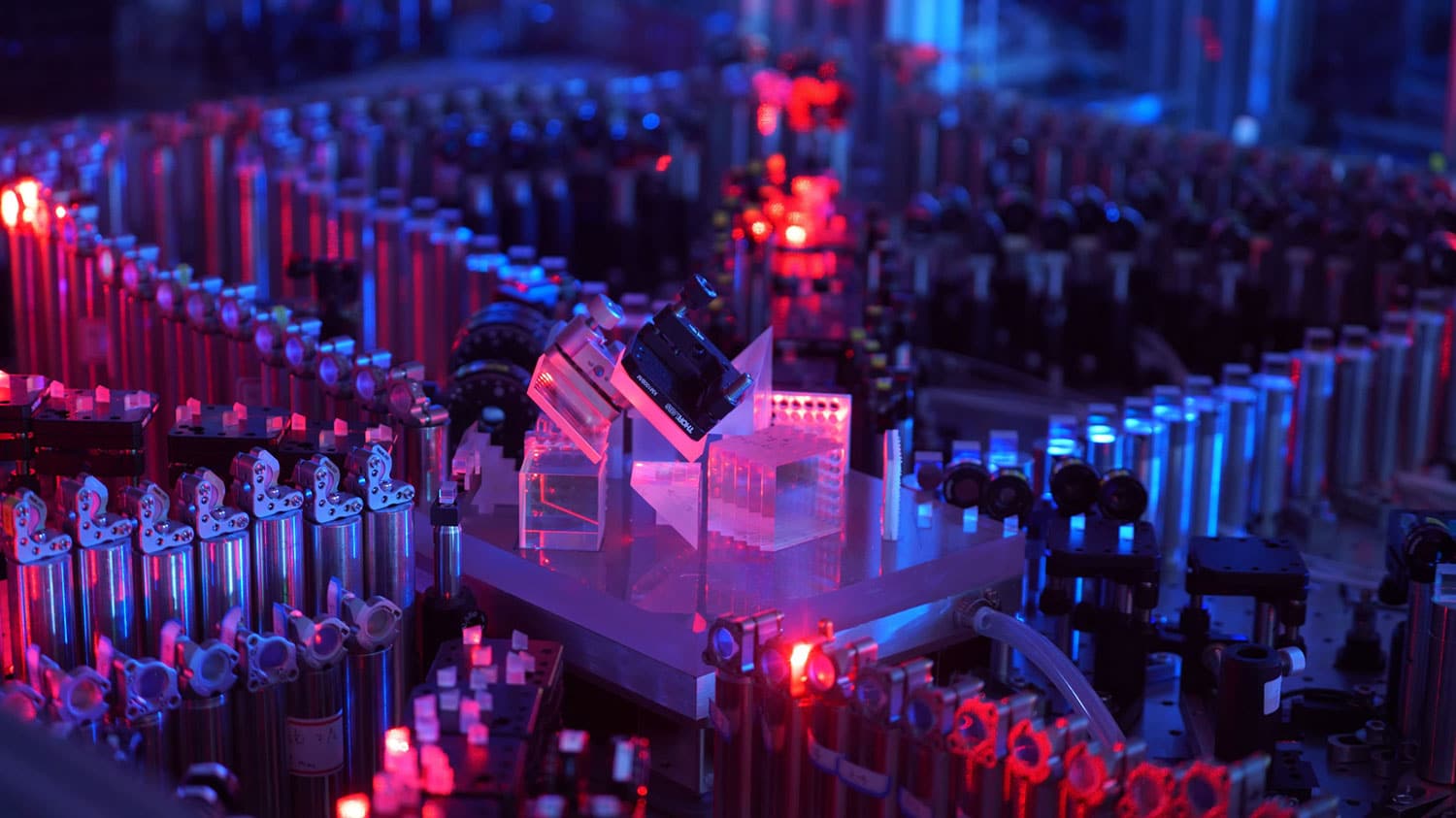
Zuchongzhi Quantum Supercomputing Picture by (University of Science and Technology of China)

Researchers in China unveiling a super-advanced 66-qubit quantum supercomputer called Zuchongzhi, which by one important metric is the most powerful machine of its kind we’ve seen to date. The performance of Zuchongzhi is undoubtedly impressive: it finished a designated quantum benchmark task in around 70 minutes, and its creators claim the world’s most powerful ‘classical’ (non-quantum) supercomputer to date would need around eight years to get through the same set of calculations.

Science Alert (Record-Breaking Chinese Supercomputer Marks New Quantum Supremacy Milestone)

For more Information, see Record-Breaking Chinese Supercomputer Marks New Quantum Supremacy Milestone

Intel Video-on-Demand at ISC21

Intel at ISC21

For more Information, do take a look at https://hpcevents.intel.com/lobby

Selected Videos.

Accelerating the Possibilities with HPC
by Trish Damkroger, VP and GM, High Performance Computing Group, Intel Corporation

Building HPC Systems with Intel for Today and Tomorrow
Jeff Watters, Director of the HPC Portfolio and Strategic Engagements, Intel Corporation

CXL Fireside Chat
Stephen Van Doren, Intel Fellow, Director of Processor Interconnect Architecture, Intel Corporation

Intel System Server D50TNP for HPC
Scott Misage, Manager Product Development & Architecture, Intel Corporation
Brian Caslis, Product Line Manager, Intel Corporation
Jim Russell, Project Design Manager, Intel Corporation

Ice Lake, Together with Mellanox Interconnect Solutions, Deliver Best in Class Performance for HPC Applications
Gilad Shainer, Senior Vice President Marketing, NVIDIA

Optimizing a Memory-Intensive Simulation Code for Heterogenous Optane Memory Systems
Steffen Christgau, HPC Consultant, Zuse Institute Berlin

For more Video, see https://hpcevents.intel.com/sessions

This new 100-qubit Quantum processors is built with ultracold atoms

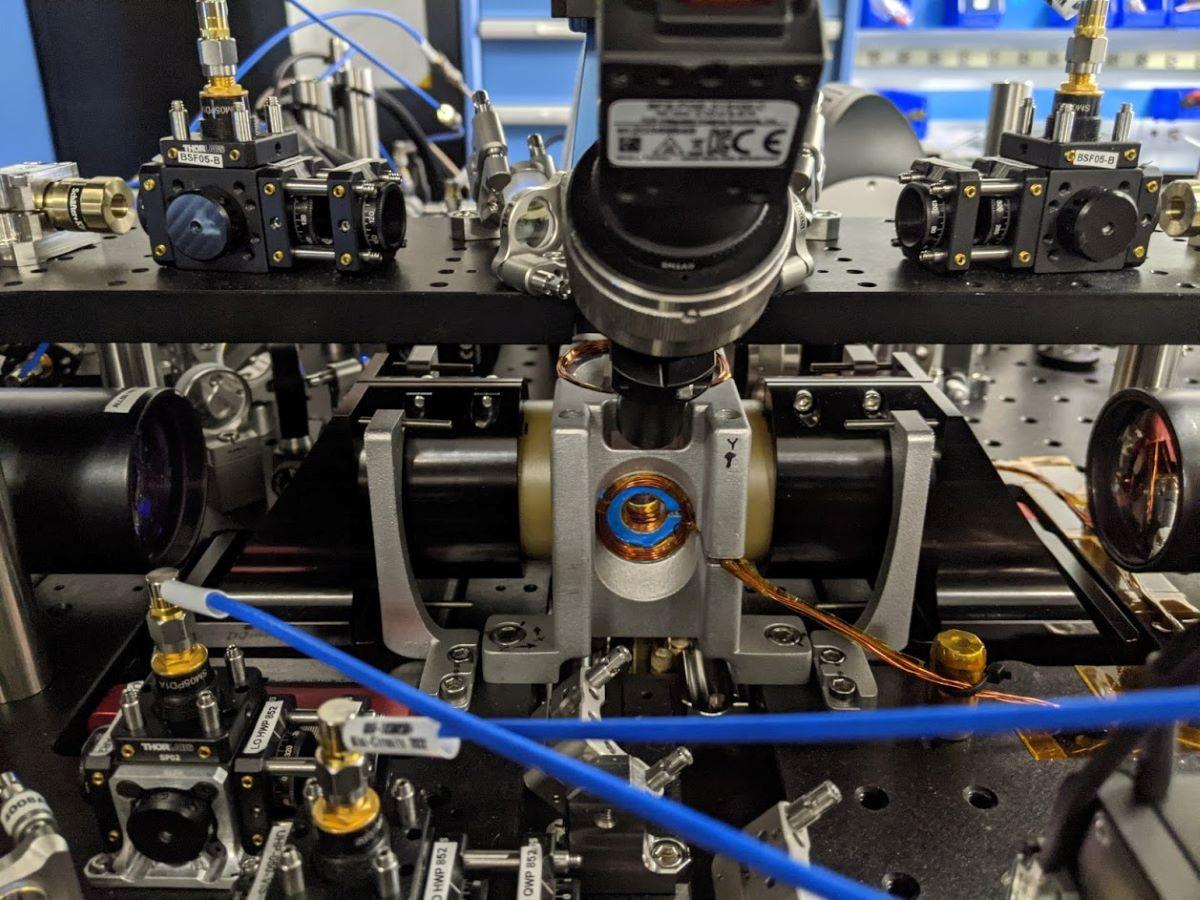
Image: ColdQuanta

By cooling atoms down to near absolute zero and then controlling them with lasers, a company has successfully created a 100-qubit quantum processor that compares to the systems developed by leading quantum players to date. ColdQuanta, a US-based company that specializes in the manipulation of cold atoms, unveiled the new quantum processor unit, which will form the basis of the company’s 100-qubit gate-based quantum computer, code-named Hilbert, launching later this year after final tuning and optimization work. here are various different approaches to quantum computing, and among those that have risen to prominence in the last few years feature superconducting systems, trapped ions, photonic quantum computers and even silicon spin qubits.

ZDNet “Quantum computing: This new 100-qubit processor is built with atoms cooled down near to absolute zero”

The Article can be found here “Quantum computing: This new 100-qubit processor is built with atoms cooled down near to absolute zero

Resolving GNU MP not found on CentOS 7

If you are installing package like BiocManager::install(“scDblFinder”)

BiocManager::install("scDblFinder")

You may encounters error like

configure: error: GNU MP not found, or not 4.1.4 or up, see http://gmplib.org

The fix is obvious as seen on error message. If you are using CentOS 7, you can easily fix it via Yum

% yum install gmp-devel

Compiling R-4.1.0 with GNU

The R Project for Statistical Computing

Prerequisites

gnu-6.5
m4-1.4.18
gmp-6.1.0
mpfr-3.1.4
mpc-1.0.3
isl-0.18
gsl-2.1

Compiling PCRE is important or you will face an error like

configure: error: PCRE2 library and headers are required, or use --with-pcre1 and PCRE >= 8.32 with UTF-8 support

After you have compile PCRE, you can proceed with the compilation of R-4.1.0

% ./configure --prefix=/usr/local/R-4.1.0 --with-pcre1=/usr/local/pcre-8.42 --with-blas --with-lapack --enable-R-shlib

If there are no issues….

R is now configured for x86_64-pc-linux-gnu

  Source directory:            .
  Installation directory:      /usr/local/R-4.1.0

  C compiler:                  gcc  -g -O2
  Fortran fixed-form compiler: gfortran  -g -O2

  Default C++ compiler:        g++ -std=gnu++14  -g -O2
  C++11 compiler:              g++ -std=gnu++11  -g -O2
  C++14 compiler:              g++ -std=gnu++14  -g -O2
  C++17 compiler:
  C++20 compiler:
  Fortran free-form compiler:  gfortran  -g -O2
  Obj-C compiler:              gcc -g -O2 -fobjc-exceptions

  Interfaces supported:        X11
  External libraries:          pcre1, readline, BLAS(generic), LAPACK(generic), curl
  Additional capabilities:     PNG, JPEG, NLS, ICU
  Options enabled:             shared R library, R profiling

  Capabilities skipped:        TIFF, cairo
  Options not enabled:         shared BLAS, memory profiling

  Recommended packages:        yes

Make and Make Install the Files

% make -j 8
.....
gcc -I"/home/user1/Downloads/R-4.1.0/include" -DNDEBUG   -I/usr/local/include   -fpic  -g -O2  -c anova.c -o anova.o
gcc -I"/home/user1/Downloads/R-4.1.0/include" -DNDEBUG   -I/usr/local/include   -fpic  -g -O2  -c anovapred.c -o anovapred.o
gcc -I"/home/user1/Downloads/R-4.1.0/include" -DNDEBUG   -I/usr/local/include   -fpic  -g -O2  -c branch.c -o branch.o
gcc -I"/home/user1/Downloads/R-4.1.0/include" -DNDEBUG   -I/usr/local/include   -fpic  -g -O2  -c bsplit.c -o bsplit.o
gcc -I"/home/user1/Downloads/R-4.1.0/include" -DNDEBUG   -I/usr/local/include   -fpic  -g -O2  -c choose_surg.c -o choose_surg.o
g
.....
% make install

References:

  1. Compiling R by Toby Dylan

A relook at InfiniBand and Ethernet Trends on Top500

I have put up a article from Nvidia Perspective on the Top 500 Interconnect Trends. There is another article put up by the NextPlatform that took a closer look at the Infiniband and Ethernet Trends

Taken from The Next Platform “The Eternal Battle Between Infiniband and Ethernet”

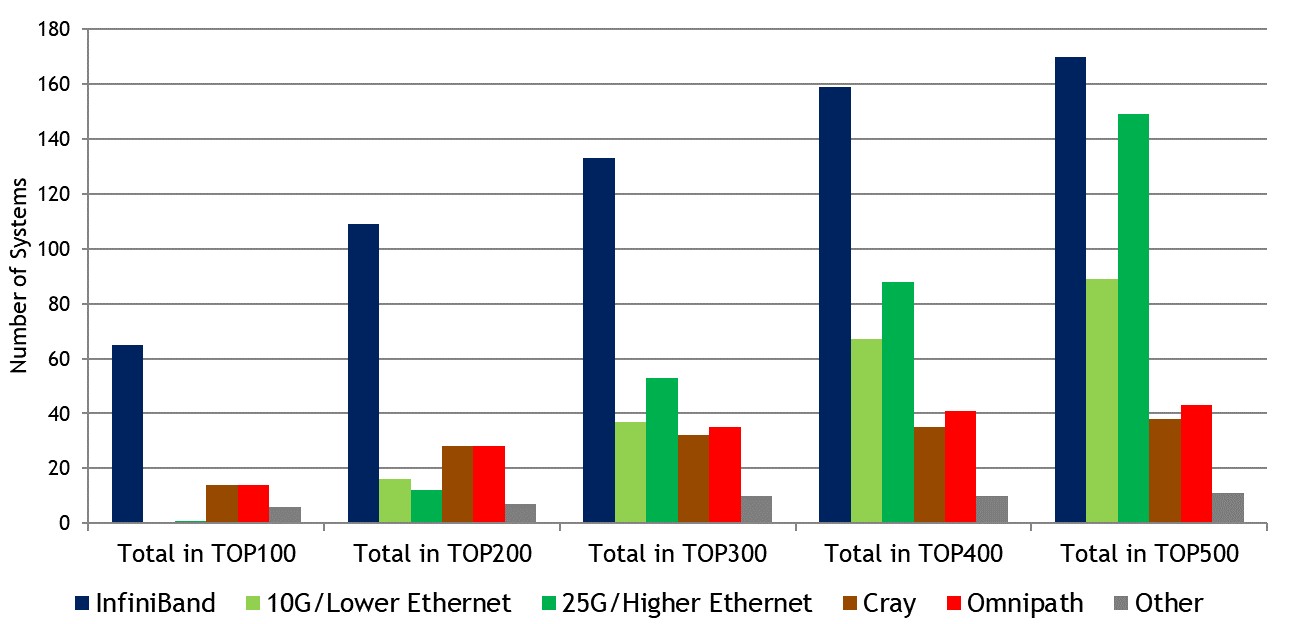
The penetration of Ethernet rises as the list fans out, as you might expect, with many academic and industry HPC systems not being able to afford InfiniBand or not willing to switch away from Ethernet. And as those service providers, cloud builders, and hyperscalers run Linpack on small portions of their clusters for whatever political or business reasons they have. Relatively slow Ethernet is popular in the lower half of the Top500 list, and while InfiniBand gets down there, its penetration drops from 70 percent in the Top10 to 34 percent in the complete Top500.

Nvidia’s InfiniBand has 34 percent share of Top500 interconnects, with 170 systems, but what has not been obvious is the rise of Mellanox Spectrum and Spectrum-2 Ethernet switches on the Top500, which accounted for 148 additional systems. That gives Nvidia a 63.6 percent share of all interconnects on the Top500 rankings. That is the kind of market share that Cisco Systems used to enjoy for two decades in the enterprise datacenter, and that is quite an accomplishment.

Taken from The Next Platform “The Eternal Battle Between Infiniband and Ethernet”

References:

The Eternal Battle Between Infiniband and Ethernet