Useful Commands for Centrify Suite

Taken from [TIPS] A Centrify Server Suite Cheat Sheet


BASIC Troubleshooting

Pt 1. To check the general status of the client

$ adinfo
Local host name: xxx
Joined to domain: xxx.com
Joined as: xxx
Pre-win2K name: xxx
Current DC: xxx
Preferred site: NTU-Site
Zone: xxx
Last password set: 2019-07-24 06:29:08 +08
CentrifyDC mode: connected
Licensed Features: Enabled

Pt 2. To see the corresponding Centrify Suite Version

$ adinfo --suite-version
adinfo (CentrifyDC 5.5.0-200)
Centrify Server Suite 2018

Pt 3. To view Active Directory connectivity to the current domain

$ adinfo --test
Domain Diagnostics:
Domain:
DNS query for:
DNS query for:
Testing Active Directory connectivity:
Domain Controller:
ldap: 389/tcp - good
ldap: 389/udp - good
smb: 445/tcp - good
kdc: 88/tcp - good
kpasswd: 464/tcp - good
ntp: 123/udp - good
Domain Controller:
ldap: 389/tcp - good
ldap: 389/udp - good
smb: 445/tcp - good
kdc: 88/tcp - good
kpasswd: 464/tcp - good
ntp: 123/udp - good
Domain Controller:
ldap: 389/tcp - good
ldap: 389/udp - good
smb: 445/tcp - good
kdc: 88/tcp - good
kpasswd: 464/tcp - good
ntp: 123/udp - good
Domain Controller:
ldap: 389/tcp - good
ldap: 389/udp - good
smb: 445/tcp - good
kdc: 88/tcp - good
kpasswd: 464/tcp - good
ntp: 123/udp - good

Pt 4: To see the current joined Centrify zone

$ adinfo --zone
xxx.com/MyOU/Centrify/Zones/Global

ADVANCED / TROUBLESHOOTING Information

Pt 5: To check the status of the DNS cache and stats

$ adinfo --diag dns
adinfo (CentrifyDC 5.5.0-200)
Host Diagnostics
uname: Linux hpc-gekko1 3.10.0-693.el7.x86_64 #1 SMP Tue Aug 22 21:09:27 UTC 2017 x86_64
OS: CentOS
Version: 7.0
Number of CPUs: 32
…..
…..

Pt 6: To check network connectivity statistics

$ adinfo --sysinfo netstate
System Diagnostic
===============Network State===================
Site Map
com.sg=>PreferredSite:XXX.com, SubnetSite:XXX-Site
Domain Map
…
…
state: alive
swept: 21 mins ago
...

Pt 7: To see the status of the AD computer trust relationship

$ adinfo --sysinfo adagent
System Diagnostic
===================adagent internals===================
Binding Table
$=>main11.main.ntu.edu.sg(MAIN.NTU.EDU.SG) connected
xxx.com=>xxx.com disconnected
xxx1=>xxx1.com disconnected
xxx2=>xxx2.com connected
xxx3=>xxx3.com connected

TESTING Credentials Information

$ adinfo -A --user myuserid
Active Directory password:
...

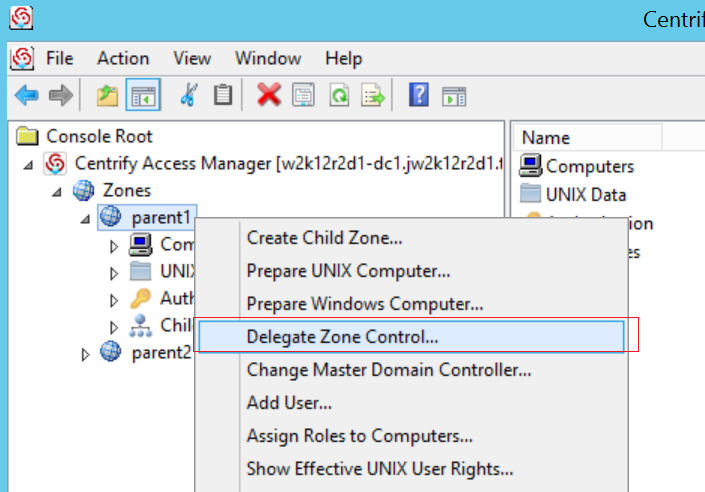
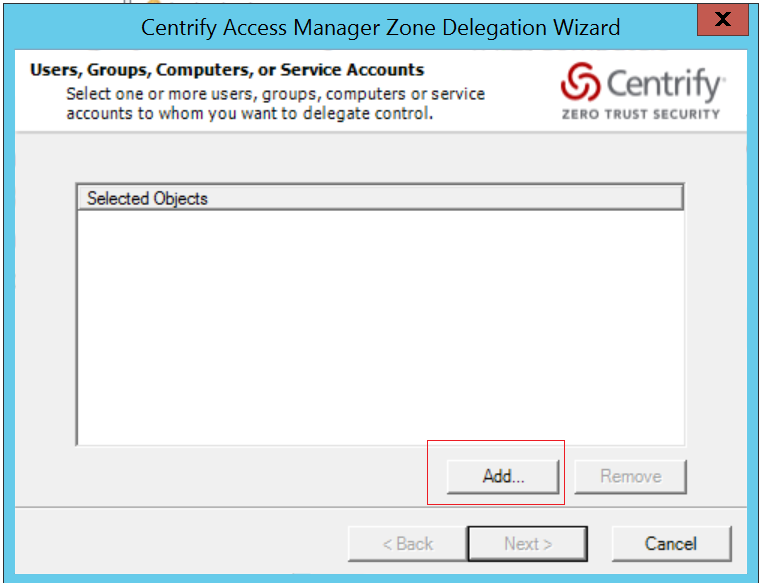
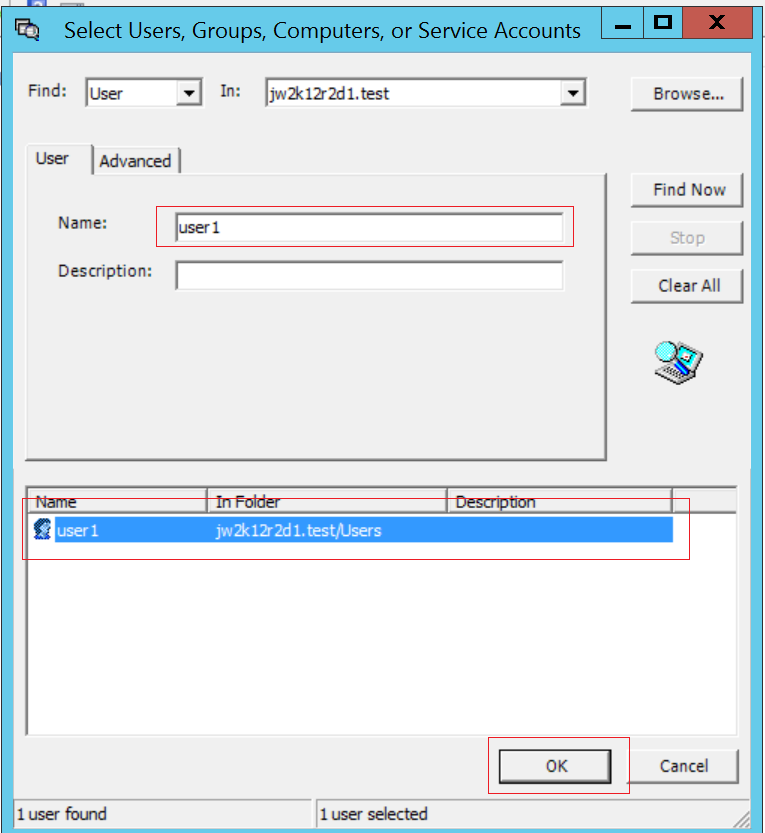
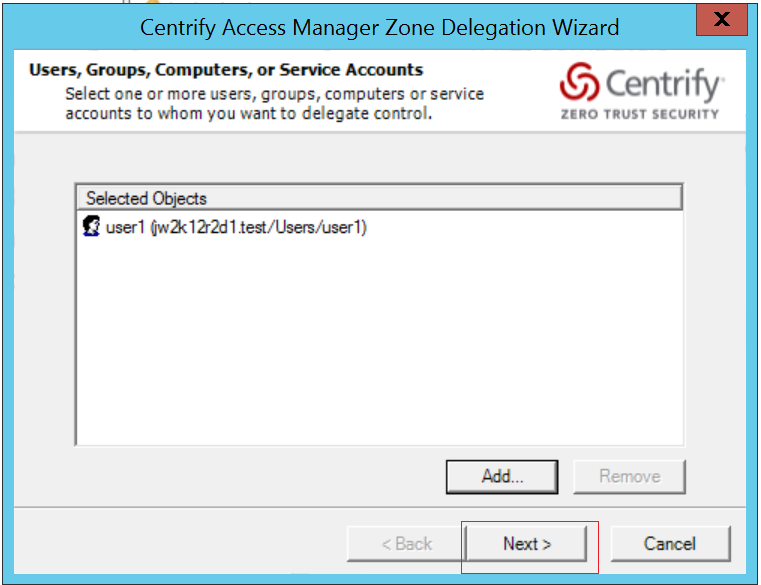
Delegate Zone Control to the user in the Centrify Management Console

  • Open Access Manager as Administrator
  • Right click “Centrify Access Manager > Zone > Global”
  • Select “Delegate Zone Control…”

  • In the Dialog window, click “Add”

  • Input user name into “Name:” field and click “Find Now”
  • Select the User and click “OK”

  • Click “Next”

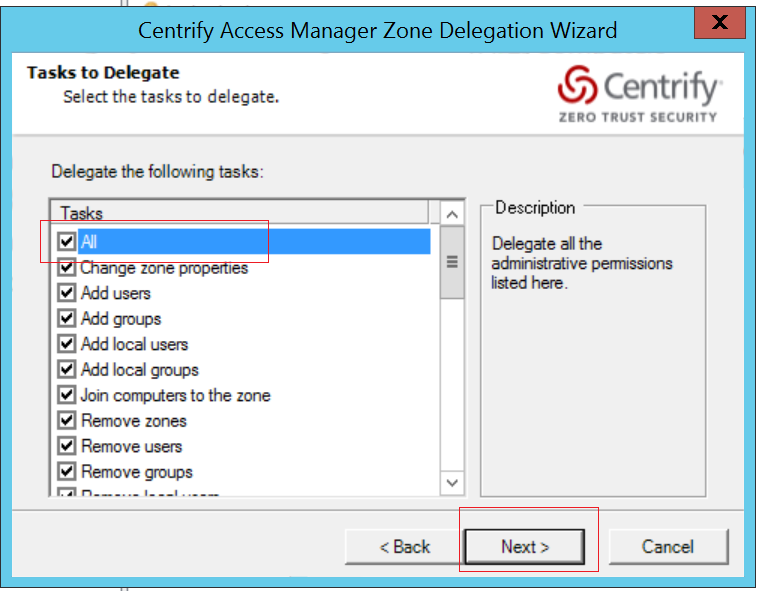
  • Click “All” in the Tasks list and click “Next”

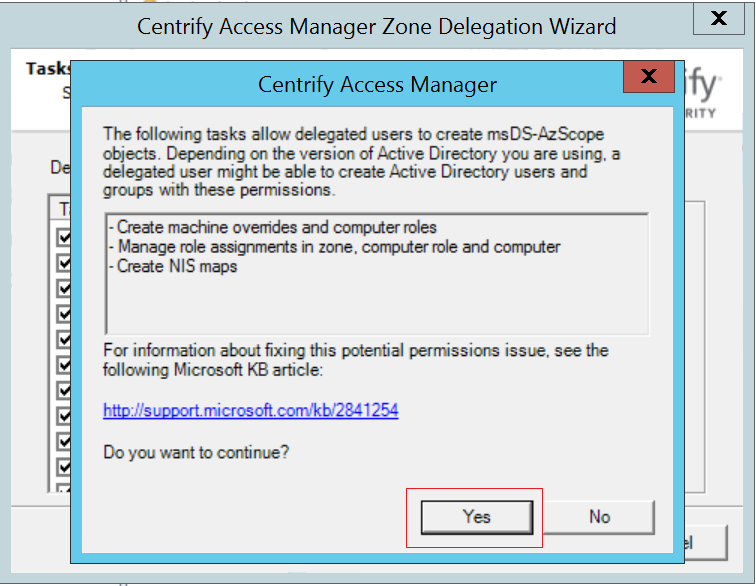
  • Click “Yes”

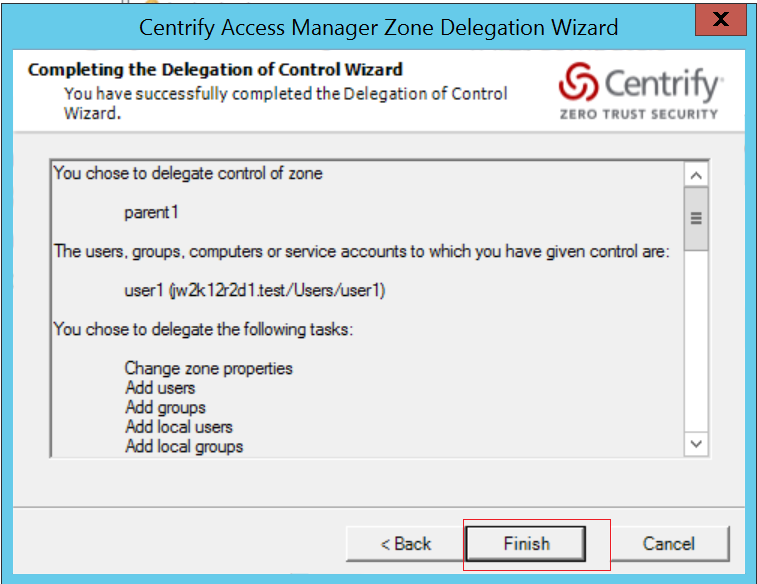
  • Click “Finish”

Resolving Orphaned Objects in Centrify Access Manager

On the Centrify Access Manager, when we search for the userid, the Centrify Access Manager is not found.
But when we add the userid in the system, it mentioned that the userid is duplicated. It seems that the userid has been cached and orphaned somewhere in Centrify.

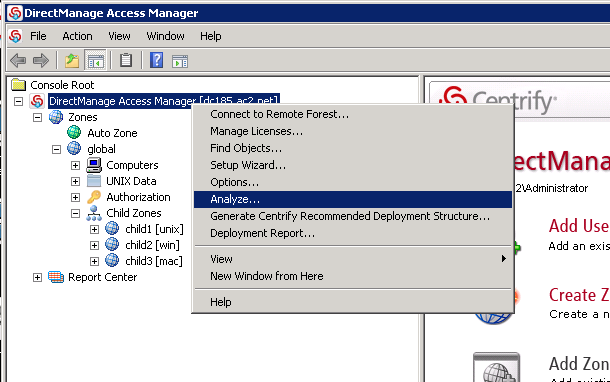
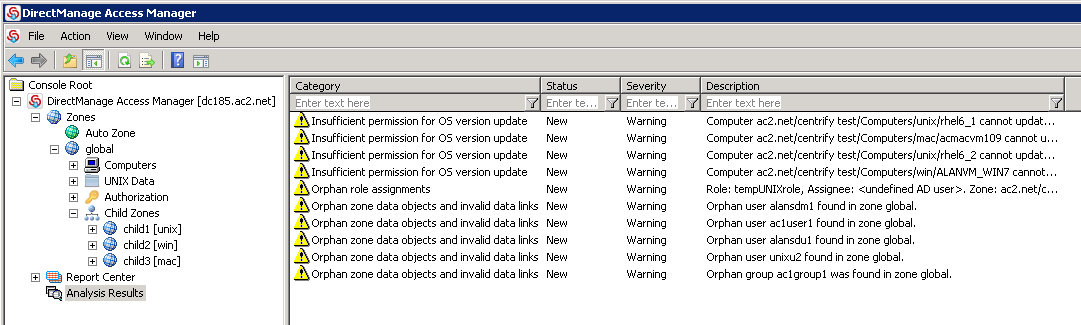
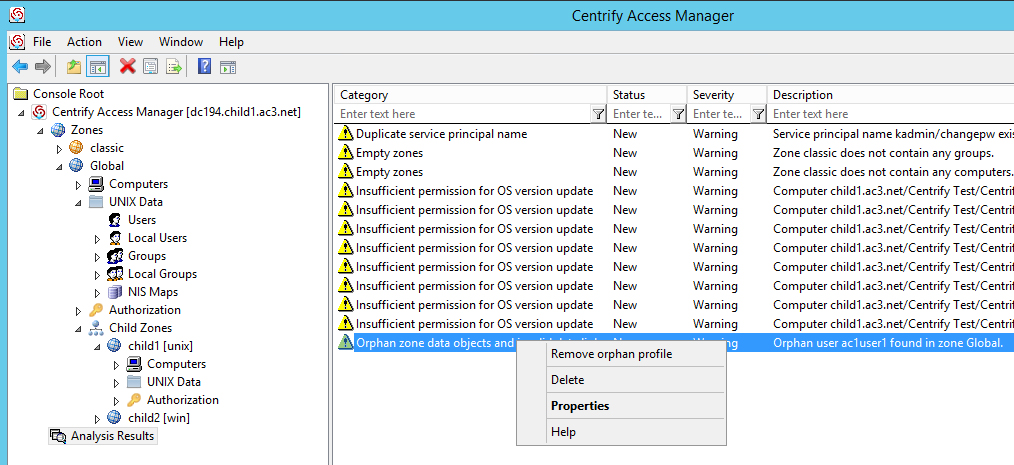
Step 1: To find out duplicated users / objects, you may use Analyze feature in Access Manager. See Pix 1

Step 2: Analyse Results

You will notice

– Duplicate users in zones
– Orphan zone data objects and invalid data links

Step 3: Right-Clicked to fix the isses

You should be able to add the user.


Rectifying Corrupted Keytab file on Centrify Client

Do the required Centrify Log Collection. Do take a look at Collecting logs from Centrify Client

If you notice the logs

============

Oct  5 20:19:06 lsf-login2 adclient[16400]: DEBUG <fd:27 PAMVerifyPassword > base.osutil Module=Kerberos : while getting service credentials: Decrypt integrity check failed (reference base/aduser.cpp:1629 rc: -1765328353) Oct  5 20:19:06 lsf-login2 adclient[16400]: DEBUG <fd:27 PAMVerifyPassword > base.aduser Unable to verify user’s credentials: while getting service credentials: Decrypt integrity check failed Oct  5 20:19:06 lsf-login2 adclient[16400]: DIAG  <fd:27 PAMVerifyPassword > daemon.ipcclient validate password caught exception: while getting service credentials: Decrypt integrity check failed Oct  5 20:19:06 lsf-login2 adclient[16400]: WARN  <fd:27 PAMVerifyPassword > audit User ‘user1’ not authenticated: while getting service credentials: Decrypt integrity check failed Oct  5 20:19:06 lsf-login2 adclient[16400]: DEBUG <fd:27 PAMVerifyPassword > daemon.ipcclient2 doPAMVerifyPassword: user ‘jliu024’ not OK: -1765328353 (Kerberos) Oct  5 20:19:06 lsf-login2 adclient[16400]: DEBUG <fd:27 PAMVerifyPassword > daemon.ipcclient2 request ‘PAMVerifyPassword’ complete =======================

To resolve the issue, do the following

# adkeytab -r -u User1

And try to restart adclient again as root

# /usr/share/centrifydc/bin/centrifydc restart

Collecting logs from Centrify Client

On the Centrify Unix server, as root or sudo, please run the following commands:

1. Turn on Centrify debug:

# /usr/share/centrifydc/bin/addebug on
# /usr/share/centrifydc/bin/addebug clear

2. Reproduce the issue, attempt to log-in.

3. Collect adinfo:

# adinfo -t

4. Turn Off Debug

# /usr/share/centrifydc/bin/addebug off

5. Run adquery and dzinfo for the selected Users:

# adquery user -A UserID1 > /tmp/adquery.txt
# dzinfo UserID1 > /tmp/dzinfo.txt

6. Send the Logs to Centrify Support

/var/centrify/tmp/adinfo_support.tar.gz
/tmp/adquery.txt
/tmp/dzinfo.txt

Testing the AD User Authentication with Centrify

Test 1: Test with SSH

The simplest way is to enable SSH and connect to it.

Test 2: Test with adinfo

# adinfo -A --user user1
Active Directory password:
Password for user "user1" is correct

Test 3: Test using kinit

# /usr/share/centrifydc/kerberos/bin/kinit user1
# /usr/share/centrifydc/kerberos/bin/klist
Ticket cache: FILE:/tmp/krb5cc_0
Default principal: user2@test.com
.....
.....
Valid starting       Expires           Service principal
.....
.....

References:

  1. Centrify is in connected mode but users are unable to login.

Compiling with NWChem-6.6 with Intel MPI-5.0.3

Here is a write-up of my computing platform and applications:

  1. NWChem 6.6 (Oct 2015)
  2. Intel Compilers 2015 XE (version 15.0.6)
  3. Intel MPI (5.0.3)
  4. Intel MKL (11.2.4)
  5. Infiniband Inteconnect (OFED 1.5.3)
  6. CentOS 6.3 (x86_64)

Step 1: First thing first, source the intel components setting from

source /usr/local/intel_2015/parallel_studio_xe_2015/bin/psxevars.sh intel64
source /usr/local/intel_2015/impi/5.0.3.049/bin64/mpivars.sh intel64
source /usr/local/intel_2015/composerxe/bin/compilervars.sh intel64
source /usr/local/intel_2015/mkl/bin/mklvars.sh intel64

Step 2: Assuming you are done, you may want to download the NWChem 6.6 from NWChem Website. You may also want to take a look at instruction set for Compiling NWChem.

I have less problem running NWCHEM when the installation and the compiling directories are the same. If you recompile, do untar from source. Somehow the “make clean” does not clean the directories properly.

# tar -zxvf Nwchem-6.6.revision27746-src.2015-10-20.tar.gz
# cd nwchem-6.6

Step 3: Apply All the Patches for the 27746 revision of NWChem 6.6

cd $NWCHEM_TOP
wget http://www.nwchem-sw.org/download.php?f=Xccvs98.patch.gz
gzip -d Xccvs98.patch.gz
patch -p0 < Xccvs98.patch

Here is my nwchem_script_Feb2017.sh. For more details information, see Compiling NWChem for details on some of the parameters

export TCGRSH=/usr/bin/ssh
export NWCHEM_TOP=/home/melvin/Downloads/nwchem-6.6
export NWCHEM_TARGET=LINUX64
export NWCHEM_MODULES=all
export LARGE_FILES=TRUE

export ARMCI_NETWORK=OPENIB
export IB_INCLUDE=/usr/include
export IB_LIB=/usr/lib64
export IB_LIB_NAME="-libumad -libverbs -lpthread"

export MSG_COMMS=MPI
export USE_MPI=y
export USE_MPIF=y
export USE_MPIF4=y
export MPI_LOC=/usr/local/RH6_apps/intel_2015/impi_5.0.3/intel64
export MPI_LIB=$MPI_LOC/lib
export MPI_INCLUDE=$MPI_LOC/include
export LIBMPI="-lmpigf -lmpigi -lmpi_ilp64 -lmpi"

export FC=ifort
export CC=icc

export MKLLIB=/usr/local/RH6_apps/intel_2015/mkl/lib/intel64
export MKLINC=/usr/local/RH6_apps/intel_2015/mkl/include

export PYTHONHOME=/usr
export PYTHONVERSION=2.6
export USE_PYTHON64=y
export PYTHONLIBTYPE=so
sed -i 's/libpython$(PYTHONVERSION).a/libpython$(PYTHONVERSION).$(PYTHONLIBTYPE)/g' config/makefile.h

export HAS_BLAS=yes
export BLAS_SIZE=8 
export BLASOPT="-L$MKLLIB -lmkl_intel_ilp64 -lmkl_core -lmkl_sequential -lpthread -lm"
export LAPACK_LIBS="-L$MKLLIB -lmkl_intel_ilp64 -lmkl_core -lmkl_sequential -lpthread -lm"
export SCALAPACK_SIZE=8
export SCALAPACK="-L$MKLLIB -lmkl_scalapack_ilp64 -lmkl_intel_ilp64 -lmkl_core -lmkl_sequential -lmkl_blacs_intelmpi_ilp64 -lpthread -lm"
export USE_64TO32=y

echo "cd $NWCHEM_TOP/src"
cd $NWCHEM_TOP/src

echo "BEGIN --- make realclean "
make realclean
echo "END --- make realclean "

echo "BEGIN --- make nwchem_config "
make nwchem_config
echo "END --- make nwchem_config "

echo "BEGIN --- make"
make CC=icc FC=ifort FOPTIMIZE=-O3 -j4
echo "END --- make "

cd $NWCHEM_TOP/src/util
make CC=icc FC=ifort FOPTIMIZE=-O3 version
make CC=icc FC=ifort FOPTIMIZE=-O3
cd $NWCHEM_TOP/src
make CC=icc FC=ifort FOPTIMIZE=-O3  link

General Site Installation

Determine the local storage path for the install files. (e.g., /usr/local/NWChem).
Make directories

# mkdir /usr/local/nwchem-6.6
# mkdir /usr/local/nwchem-6.6/bin
# mkdir /usr/local/nwchem-6.6/data

Copy binary

# cp $NWCHEM_TOP/bin/ /usr/local/nwchem-6.6/bin
# cd /usr/local/nwchem-6.6/bin
# chmod 755 nwchem

Copy libraries

# cd $NWCHEM_TOP/src/basis
# cp -r libraries /usr/local/nwchem-6.6/data

# cd $NWCHEM_TOP/src/
# cp -r data /usr/local/nwchem-6.6

# cd $NWCHEM_TOP/src/nwpw
# cp -r libraryps /usr/local/nwchem-6.6/data

The Final Lap (From Compiling NWChem)

Each user will need a .nwchemrc file to point to these default data files. A global one could be put in /usr/local/nwchem-6.6/data and a symbolic link made in each users $HOME directory is probably the best plan for new installs. Users would have to issue the following command prior to using NWChem: ln -s /usr/local/nwchem-6.6/data/default.nwchemrc $HOME/.nwchemrc

Contents of the default.nwchemrc file based on the above information should be:

nwchem_basis_library /usr/local/nwchem-6.6/data/libraries/
nwchem_nwpw_library /usr/local/nwchem-6.6/data/libraryps/
ffield amber
amber_1 /usr/local/nwchem-6.6/data/amber_s/
amber_2 /usr/local/nwchem-6.6/data/amber_q/
amber_3 /usr/local/nwchem-6.6/data/amber_x/
amber_4 /usr/local/nwchem-6.6/data/amber_u/
spce    /usr/local/nwchem-6.6/data/solvents/spce.rst
charmm_s /usr/local/nwchem-6.6/data/charmm_s/
charmm_x /usr/local/nwchem-6.6/data/charmm_x/

References:

  1. 470. Very briefly: compiling nwchem 6.3 with ifort and mkl
  2. Compiling NWChem from source
  3. Problem building NWChem version 6.5 on IB cluster with MKL & IntelMPI