
In this video from SC19, Dr. Eng Lim Goh from HPE describes how the convergence of HPC and AI is changing the way scientists and engineers do their simulations.
Author: kittycool only
IBM Singapore Supercomputing Virtual Forum 30 June 2020

Overview:
In the past few months, technology has been put on a test like never before. On one hand healthcare research professionals have be grappling with the onset of a pandemic, trying to find answers in data and numbers. On the other hand, corporates are struggling to make sure that continuity is maintained in order to minimize long term economic impact. In some form or the other, both segments are embracing technology for a better future. Join us for this virtual summit where we bring in the experts from the domain of HPC, AI and Quantum to explore how the paradigm has shifted from what we ‘want’ to what we ‘essentially need’ from Tech for Good.
For more information, do take a look at https://www.ibm.com/sg-en/events/supercomputing
G16NBO is currently configured with only 100000000 words Errors

If you encounter errors when you use NBO7 with Gaussian G16a
This calculation is attempting to allocate 299857248 words of scratch memory,
but G16NBO is currently configured with only 100000000 words. If you have the
NBO6 source distribution, you can reconfigure G16NBO by editing maxmem.fh in
nbo6/src/g16nbo/include and rebuilding the executables.
Dynamic memory allocation in the GenNBO, G09NBO, and G16NBO interfaces to NBO7 has been implemented. The issue has been fixed with the latest download from NBO7 site.
Remember to update gennbo.sh at your NBO directory
# Examples:

# setenv NBOMEM 50mw
# setenv NBOMEM 512mb
# setenv NBOMEM 1gb

setenv NBOMEM 1gb
References:
Webinar – Advanced automation techniques with Ansible and Red Hat Training
To register for the Online Seminar, click HERE

Webinar – The promises of the One Health concept in the age of anthropocene

TITLE: The promises of the One Health concept in the age of anthropocene
SPEAKER: dr Aneta Afelt, Interdisciplinary Centre for Mathematical and Computational Modelling, University of Warsaw | Espace-DEV, IRD – Institut de Recherche pour le Développement, Montpellier, France
DATE&TIME: Thursday, May 28, 2020 at 4:00 PM (CEST)
ABSTRACT:
In May 2019 an article was published: Anthropocene now: influential panel votes to recognise Earth’s new epoch situating at the stratigraphy of Earth’s history a new geological epoch – the domination of human influence on shaping the Earth’s environment. When humans are a central figure in an ecological niche it results in massive subordination and transformation of the environment for their needs. Unfortunately, the outcome of such actions is a robbery of natural resources. The consequences are socially unexpected – a global epidemiological crisis. The current COVID-19 pandemic is an excellent example. It seems that one of the most important questions of the anthropocene era is how to maintain stable epidemiological conditions for now and in the future. The One Health concept proposes a new paradigm – a deep look at the sources of our well-being: our relationship with the environment. Our health status is interdependent with the well-being of the environment. It is clear that the socio-ecological niche disturbance results in the spread of pathogens. Can sustainable development of socio-ecological niches help us?
Let’s take a look at the results!
SPEAKER’S BIO:
ANETA AFELT: Aneta Afelt, PhD, is a geographer working in the area of health geography. Her interest in research is the One Health concept, where environment, epidemiology and epizootiology are considered as interconnected processes located in social-ecological niches. She shows in the research results that the destruction of ecosystems results inepidemiological consequences. She works at the Interdisciplinary Center for Mathematical and Computational Modeling of the University of Warsaw, Poland, and is currently a Guest Researcher at Espace-DEV, IRD – Institut de Recherche pour le Développement, Montpellier, France. She is also a member of the scientific committee for Covid-19 of the Ministry of Science in Poland and a scientific consultant of the European Research Agency for actions dedicated to Covid-19.
PLEASE REGISTER AT:
https://supercomputingfrontiers.eu/2020/tickets/neijis7eekieshee/
Checking Disk Usage within the subfolders
I like this command which I often use to look into the dish usages at the sub folder level to check for large usages
% du -h -d 1
1.3M    ./Espresso-BEEF
65M     ./MATLAB
478M    ./Abaqus
10G     ./COMSOL
8.3M    ./Gaussian2
316K    ./scripts
4.9M    ./NB07
647M    ./pytorch-GAN
31M     ./Gaussian
12G     .
where
- -h refers to human-readable
- -d refers to depth level. By default, it is 0 which is the same as summarize
Webinar – Best of Healthcare with ANSYS
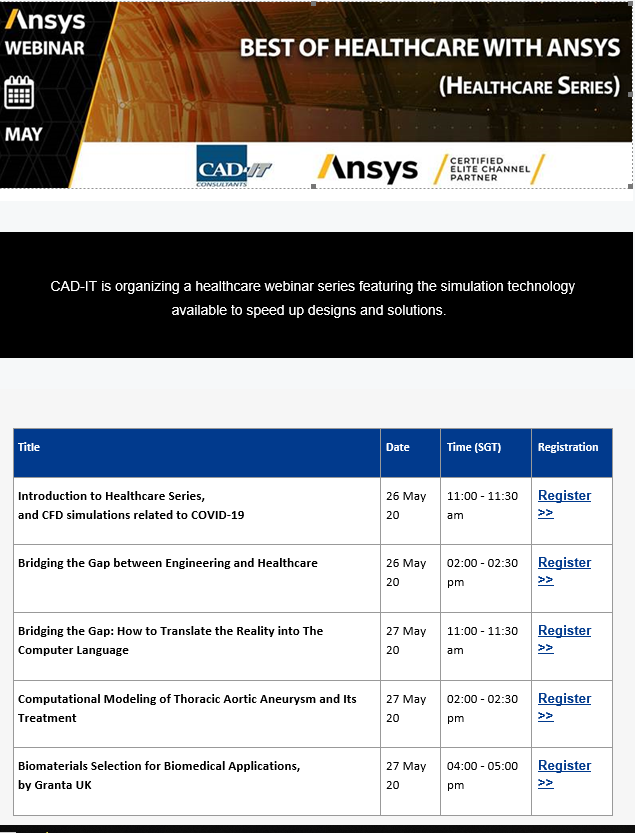
Introduction to Healthcare Series
26 May 2011:00 – 11:30 am (SGT)
Bridging the Gap between Engineering and Healthcare
26 May 2002:00 – 02:30 pm (SGT)
Bridging the Gap: How to Translate the Reality into The Computer Language
27 May 2011:00 – 11:30 am (SGT)
Computational Modeling of Thoracic Aortic Aneurysm and Its Treatment
27 May 2002:00 – 02:30 pm (SGT)
Biomaterials Selection for Biomedical Applications
27 May 2004:00 – 05:00 pm (SGT)
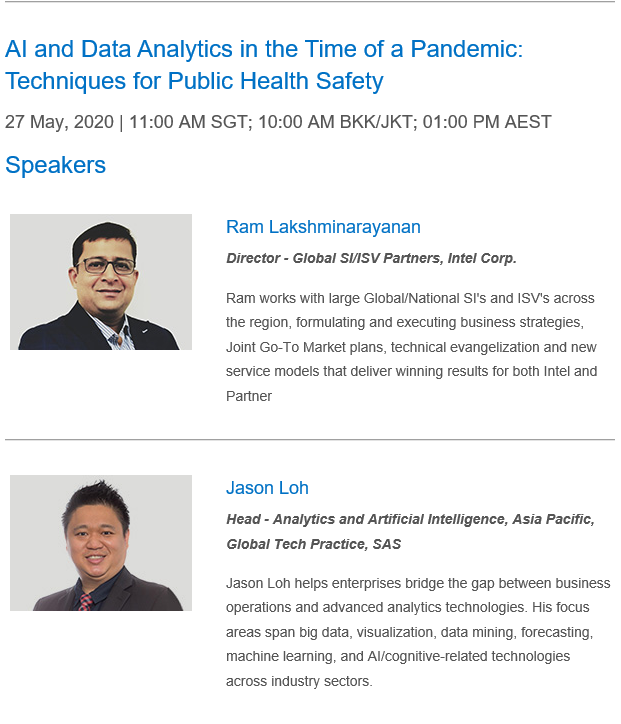
AI and Data Analytics in the Time of a Pandemic
Fabric Debug Initiation using ibdiagnet (Part 1)

Learn some of these steps from Mellanox Academy Online Training
Step 1: Clear all counters and begin the test execution
ibdiagnet -pc
Wait for a while. Usually, it may take 30 to 60 mins
Check for errors that exceed the allowed threshold
ibdiagnet -ls 25 -lw 4x -P all=1 --pm_pause_time 30
- Specify the link speed
-ls <2.5|5|10|14|25|50> - Specify the Link width
-lw <1x|4x|8x|12x> - Check Information provide from all counters and display each one of them crossing threshold of 1
-P all=1 - The time between the two samples is set by the –pm_pause_time option
Checking Priority of Queues for PBS Professional

Nifty one-liner to check on queue priority
qmgr -c " p q @default" | grep -i Prioityset queue queue1 Priority = 150
set queue queue2 Priority = 200
set queue queue3 Priority = 300 The Linux Cluster