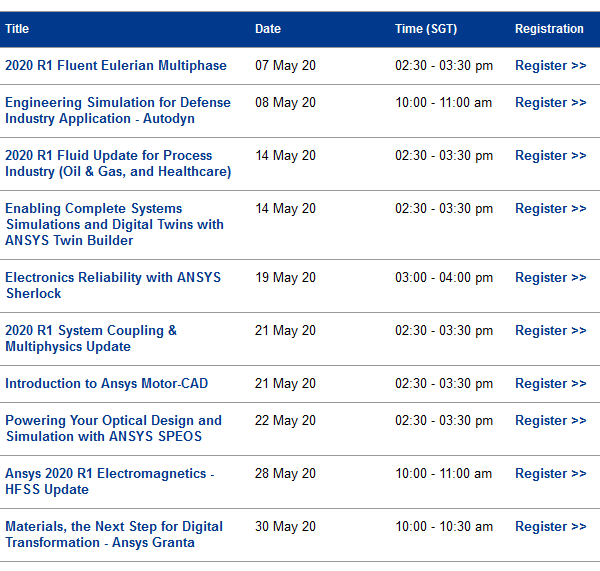
CAD-IT organised free ANSYS webinars in May. For more free information, do sign up at https://preview.mailerlite.com/i8s9f3


Research infrastructures play a key role in delivering high quality scientific data to many scientific communities. In the future, we will face a tremendous increase in data volume and rate at these facilities. This will fundamentally change the role of computing at these facilities. With this change new possibilities of using supercomputers for science arise. We will discuss how that future might look like, what is necessary to bring it to reality and – most importantly – how this will allow to foster interdisciplinary science in a complex world.
This presentation will argue that cyberattacks impair not just security but also Quality of Service,
and that they increase Energy Consumption in Systems and Networks. Thus not only do they cause damage to the users of a system, but they also impair its reputation and trust, and increase its operating costs. We will also take the view that these are dynamic phenomena which take place unexpectedly. Therefore future systems will have to constantly observe their own state to be able to very rapidly react to dynamic attacks. We will suggest a Self-Aware approach to dynamically respond to cyberattacks based on the Cognitive Packet Network dynamic routing algorithm that uses Recurrent Random Neural Networks and Reinforcement Learning. Illustrations will be provided from two FP7 and H2020 that I have proposed and which were funded by the European Union
Altair Access provides a simple, powerful, and consistent interface for submitting and monitoring jobs on remote clusters, clouds, and other resources, allowing engineers and researchers to focus on core activities and spend less time learning how to run applications and moving data around.
Live Webinar
Thur, April 23rd
11:00 AM – 12:00 PM SGT | 01:00 PM – 02:00 PM AEST
Click here to Register

Who should attend:
HPC engineers, scientists and administrators who would like to access HPC from anywhere with ease of use. Anyone who has interest in learning High Performance Computing.
Most compilers today support OpenMP. Here is a video compilation of of how Jeff Cogswell shows you how to compile OpenMP programs using both the Intel and GNU C++ compilers. Taken from Use GNU C++ and Intel Compilers with OpenMP from http://goparallel.sourceforge.net
 The Linux Cluster