IBM Singapore Supercomputing Virtual Forum 30 June 2020

Overview:

In the past few months, technology has been put on a test like never before. On one hand healthcare research professionals have be grappling with the onset of a pandemic, trying to find answers in data and numbers. On the other hand, corporates are struggling to make sure that continuity is maintained in order to minimize long term economic impact. In some form or the other, both segments are embracing technology for a better future. Join us for this virtual summit where we bring in the experts from the domain of HPC, AI and Quantum to explore how the paradigm has shifted from what we ‘want’ to what we ‘essentially need’ from Tech for Good.

For more information, do take a look at https://www.ibm.com/sg-en/events/supercomputing


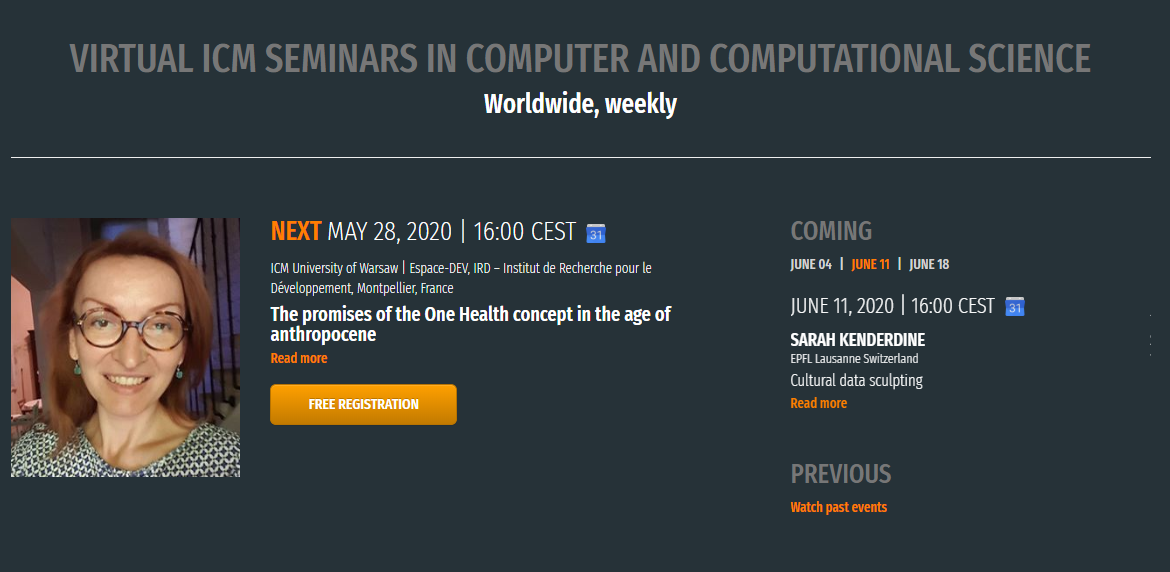
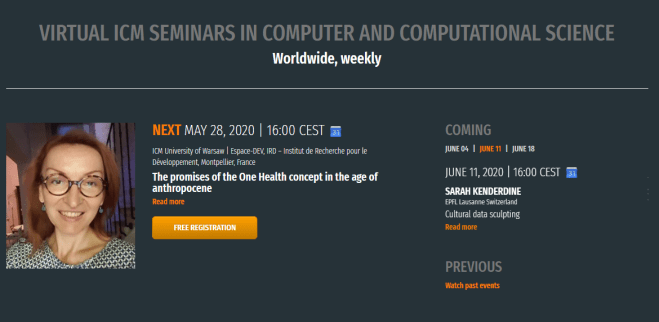
Webinar – The promises of the One Health concept in the age of anthropocene


TITLE: The promises of the One Health concept in the age of anthropocene


SPEAKER: dr Aneta Afelt, Interdisciplinary Centre for Mathematical and Computational Modelling, University of Warsaw | Espace-DEV, IRD – Institut de Recherche pour le Développement, Montpellier, France


DATE&TIME: Thursday, May 28, 2020 at 4:00 PM (CEST)


ABSTRACT:

In May 2019 an article was published: Anthropocene now: influential panel votes to recognise Earth’s new epoch situating at the stratigraphy of Earth’s history a new geological epoch – the domination of human influence on shaping the Earth’s environment. When humans are a central figure in an ecological niche it results in massive subordination and transformation of the environment for their needs. Unfortunately, the outcome of such actions is a robbery of natural resources. The consequences are socially unexpected – a global epidemiological crisis. The current COVID-19 pandemic is an excellent example. It seems that one of the most important questions of the anthropocene era is how to maintain stable epidemiological conditions for now and in the future. The One Health concept proposes a new paradigm – a deep look at the sources of our well-being: our relationship with the environment. Our health status is interdependent with the well-being of the environment. It is clear that the socio-ecological niche disturbance results in the spread of pathogens. Can sustainable development of socio-ecological niches help us?

Let’s take a look at the results!


SPEAKER’S BIO:

ANETA AFELT: Aneta Afelt, PhD, is a geographer working in the area of health geography. Her interest in research is the One Health concept, where environment, epidemiology and epizootiology are considered as interconnected processes located in social-ecological niches. She shows in the research results that the destruction of ecosystems results inepidemiological consequences. She works at the Interdisciplinary Center for Mathematical and Computational Modeling of the University of Warsaw, Poland, and is currently a Guest Researcher at Espace-DEV, IRD – Institut de Recherche pour le Développement, Montpellier, France. She is also a member of the scientific committee for Covid-19 of the Ministry of Science in Poland and a scientific consultant of the European Research Agency for actions dedicated to Covid-19.


PLEASE REGISTER AT:

https://supercomputingfrontiers.eu/2020/tickets/neijis7eekieshee/

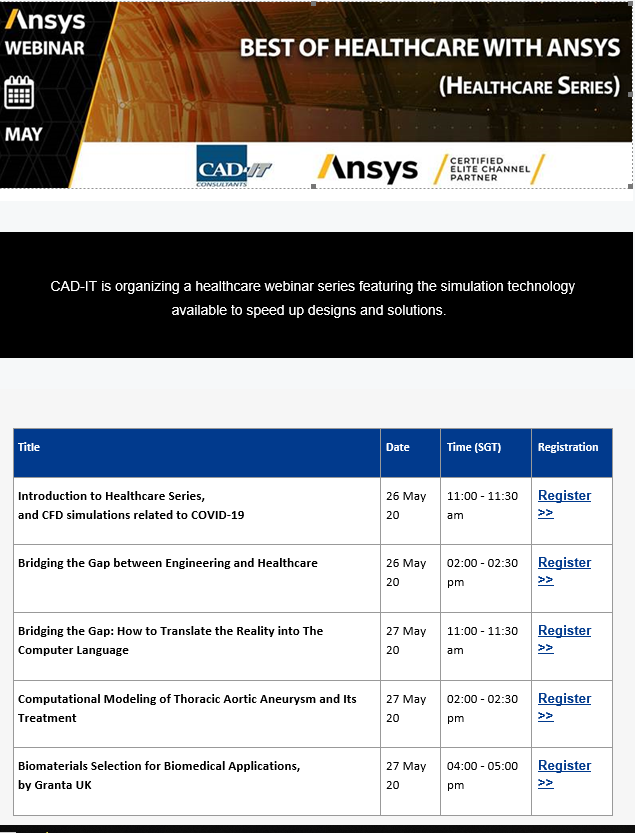
Webinar – Best of Healthcare with ANSYS

Introduction to Healthcare Series

26 May 2011:00 – 11:30 am (SGT)

Register >>


Bridging the Gap between Engineering and Healthcare

26 May 2002:00 – 02:30 pm (SGT)

Register >>


Bridging the Gap: How to Translate the Reality into The Computer Language

27 May 2011:00 – 11:30 am (SGT)

Register >>


Computational Modeling of Thoracic Aortic Aneurysm and Its Treatment

27 May 2002:00 – 02:30 pm (SGT)

Register >>


Biomaterials Selection for Biomedical Applications

27 May 2004:00 – 05:00 pm (SGT)

Register >>

Webinar – Altair 2020 Global Experience

Altair_Conference_2020

Join Altair in our virtual interactive environment to learn about the most significant update release of Altair software in the history of Altair. See how virtual validation will proceed with greater certainty across multiple physics domains.

  • Learn how simulation-driven design can improve your development efficiency, optimize product performance, and accelerate growth
  • See the latest Altair product developments for both customers new to simulation and experts in computer-aided engineering (CAE)
  • Discover how smart data insights, high-performance computing and cloud solutions can help you solve your toughest challenges

Watch keynote speakers, view technical sessions, and communicate live with product experts

For more information, see https://altair2020.virtual.altair.com/

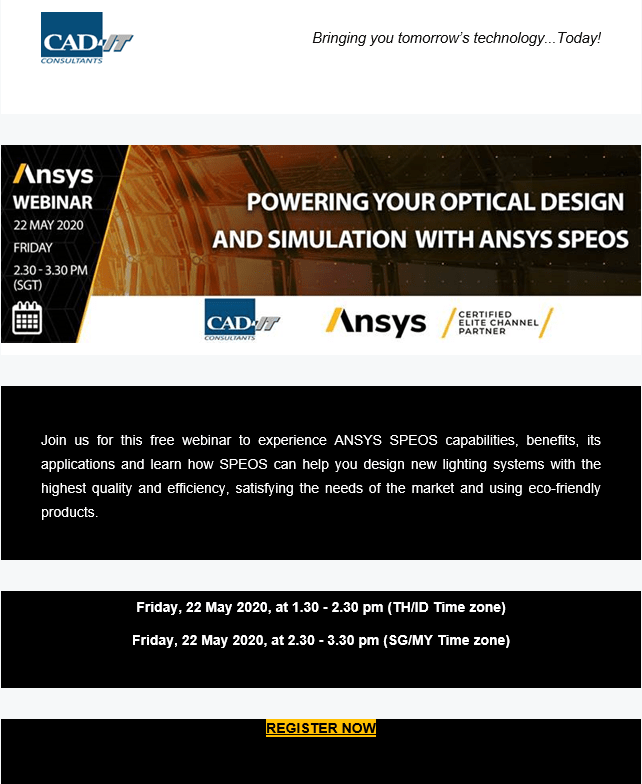
Webinar – Powering Your optical Design and Simulation with ANSYS SPEOS

CADIT_ANSYS_22May2020

ANSYS SPEOS
ANSYS SPEOS enable you to design and optimize your optical system quickly and easily, speed your time to market, reduce your physical prototyping and your development time. SPEOS combines lighting performance modeling with extensive, dedicated libraries and optimization capabilities. With SPEOS, you can study the interactions of photons with mechanical geometries to quickly create a functional illumination system for your product. It is a perfect tools for designing, validate and optimize performance of automotive lighting systems, aerospace and deference optic systems, optical sensor test for AV/ADAS and general lightings.

To Register

Webinar – Build the Most Powerful Data Center with GPU Computing Technology and High-speed Interconnect

Build the Most Powerful Data Center with GPU Computing Technology and High-speed Interconnect

Date: Thursday, June 11, 2020
Time: 11:00am-12:30pm Singapore Time

Register here 

Please join NVIDIA as we discuss how to design a well-balanced system that maximizes performance and scalability of various workloads using NVIDIA GPUs and interconnect

Speakers will provide an overview of the state-of-the-art NVIDIA GPU accelerated compute architecture and In-Network computing fabric and how they come together with one goal: to deliver a solution that democratizes supercomputing power, making it readily accessible, installable, and manageable in a modern business setting. To learn more about this webinar click here

Predicting the course of the COVID-19 epidemic in Poland

Virtual_ICM_Seminar_21May2020

TITLE: Predicting the course of the COVID-19 epidemic in Poland

SPEAKER: Franciszek Rakowski, affiliated Researcher at ICM University of Warsaw; principal Data Scientist at the AI institute, Samsung R&D, Poland

DATE&TIME: Thursday, May 21, 2020 at 4:00 PM (CEST)

PLEASE REGISTER AT:
https://supercomputingfrontiers.eu/2020/tickets/neijis7eekieshee/

ABSTRACT:
One of the most promising approaches to predicting the possible scenarios of the epidemic is based on agent-based models. The idea of that model family is quite simple: reproduce the demographic and sociological structure of the society, and run the simulations of the disease spread throughout that structure. The direct reproduction of the contact structure allows investigating the consequences of various administrative measures applied, like school closure or travel restrictions. The model results can be visualised as a dynamic map of spreading disease, and enables the assessment of burden of disease factors locally. Our model, constructed more than 10 years ago for influenza epidemics, has been reanimated and tuned to COVID-19 parameters. It is now producing both scientific results as well as pragmatic reports, which are then being passed to Polish governmental authorities.

SPEAKER’S BIO:
FRANCISZEK RAKOWSKI: Affiliated Researcher at ICM University of Warsaw.
Principal Data Scientist at the AI institute, Samsung R&D, Poland. Almost 10 years ago, when working at ICM UW as researcher, he led a project to construct a large-scale agent-based epidemic spread model for influenza disease. Recently, during the times of COVID-19 pandemic, he became the project leader of development and adaptation of the ICM Epidemic Model to the coronavirus disease. His interests also cover cognitive science, neuroscience and computational biology.