HipBone “is a fully GPU-accelerated C++ implementation of the original NekBone CPU proxy application with several novel algorithmic and implementation improvements which optimize its performance on modern finegrain parallel GPU accelerators.”
A multi-institution research team utilized Cori, a high performance computing system at the National Energy Research Scientific Computing Center, to analyze “resource disaggregation to enable finer-grain allocation of hardware resources to applications.”
Computer scientists from the University of Illinois at Urbana-Champaign and Lawrence Livermore National Laboratory demonstrated improved scalability to hide communication behind computation with GPU-aware asynchronous tasks.
HPC integrators can help scientists and HPC research centres through the provisioning and management of HPC clusters. As the number of applications and potential user groups for HPC continues to expand supporting domain expert scientists use and access of HPC resources is increasingly important.
While just ten years ago a cluster would have been used by just a few departments at a University, now there is a huge pool of potential users from non-traditional HPC applications. This also includes Artificial intelligence (AI) and machine learning (ML) as well as big data or applying advanced analytics to data sets from research areas that would previously not be interested in the use of HPC systems.
This culminates in a growing need to support and facilitate the use of HPC resources in academia or research and development. These organisations can either choose to employ the staff to support this infrastructure or try to outsource some or all of these processes to companies experienced in the management and support of HPC systems.
Producing digital coins is not environmentally friendly, to say the least. Bitcoin mining – one of the best-known implementations of blockchain – consumes around 110 Terawatt Hours per year, which is more than the annual consumption of countries such as Sweden or Argentina.
The project involves running open-source simulations to study how the speed of transactions on the blockchain could be increased using various techniques, such as sharding.
Sharding implies splitting a blockchain network into smaller partitions called ‘shards’that work in parallel to increase its transactional throughput. In other words, it’s like spreading out the workload of a network to allow more transactions to be processed, a technique similar to that used in supercomputing.
In the world of high-performance computers, ways to parallelize computation have been developed for decades to increase scalability. This point is where lessons learned from supercomputing come in handy.
“A blockchain like Ethereum is something like a global state machine, or in less technical words, a global computer. This global computer has been running for over five years on a single core, more specifically a single chain,” Bautista tells ZDNet.
“The efforts of the Ethereum community are focused on making this global computer into a multi-core computer, more specifically a multi-chain computer. The objective is to effectively parallelize computation into multiple computing cores called ‘shards’ – hence the name of this technology.”
ZDNet “Supercomputing can help address blockchain’s biggest problem. Here’s how”
A group of researchers led by Martin Schulz of the Leibniz Supercomputing Center (Munich) presented a paper in which they argue HPC architectural landscape of High-Performance Computing (HPC) is undergoing a seismic shift.
4 Guiding Principles for the Future of HPC Architecture
Energy consumption is no longer merely a cost factor but also a hard feasibility constraint for facilities.
Specialization is key to further increase performance despite stagnating frequencies and within limited energy bands.
A significant portion of the energy budget is spent moving data and future architectures must be designed to minimize such data movements.
Large-scale computing centers must provide optimal computing resources for increasingly differentiated workloads.
Ideas Snippets – Integrated Heterogeneity
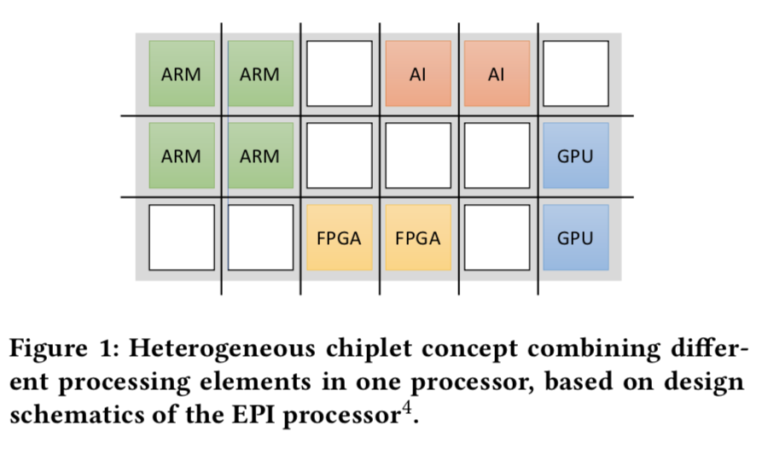
Integrated Heterogenous Systems are a promising alternative, which integrate multiple specialized architectures on a single node while keeping the overall system architecture a homogeneous collection of mostly identical nodes. This allows applications to switch quickly between accelerator modules at a fine-grained scale, while minimizing the energy cost and performance overhead, enabling truly heterogeneous applications.
Integrated HPC Systems and How They will Change HPC System Operations
Leibniz-SC-Paper_fig1-768×449
Ideas Snippets – Challenges of a Integrated Heterogeneity
a single application is likely not going use all specialized compute elements at the same time, leading to idle processing elements. Therefore, the choice of the best-suited accelerator mix is an important design criterion during procurement, which can only be achieved via co-design between the computer center and its users on one side and the system vendor on the other. Further, at runtime, it will be important to dynamically schedule and power the respective compute resources. Using power overprovisioning, i.e., planning for a TDP and maximal node power that is reached with a subset of dynamically chosen accelerated processing elements, this can be easily achieved, but requires novel software approaches in system and resource management.”
They note the need for programming environments and abstractions to exploit the different on-node accelerators. “For widespread use, such support must be readily available and, in the best case, in a unified manner in one programming environment. OpenMP, with its architecture-agnostic target concept, is a good match for this. Domain-specific frameworks, as they are, e.g., common in AI, ML or HPDA (e.g., Tensorflow, Pytorch or Spark), will further help to hide this heterogeneity and help make integrated platforms accessible to a wide range of users
HPCWire – Summer Reading: “High-Performance Computing Is at an Inflection Point”
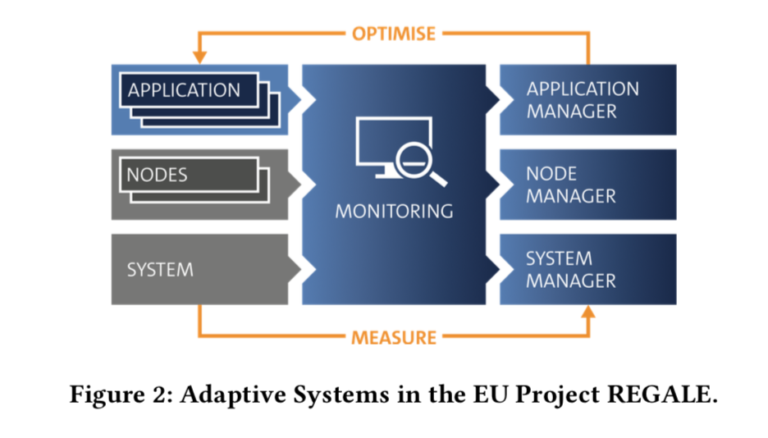
Idea Snippets – Coping with Idle Periods among different Devices (Project Regale)
Application Level. Changing application resources in terms of number and type of processing elements dynamically.
Node Level. Changing node settings, e.g. power/energy consumption via techniques like DVFS or power capping as well as node level partitioning of memory, caches, etc.
System Level. Adjusting system operation based on work- loads or external inputs, e.g., energy prices or supply levels.
HPCWire – Summer Reading: “High-Performance Computing Is at an Inflection Point”




 The Linux Cluster